Posts

Showing posts with the label 109

Help with 109 workshop 2 moles to masses table

Image
I expect a lot of you have been struggling with the table on page 41 of your 109 workbook.  Let me try to work through it for you (this is going to be a long post!). This table looked something like this: If you read the previous question, you will realise that this table wants values for alanine.  In the previous question you were asked to calculate the  relative molecular mass  of alanine - remember, this is equivalent to the  mass of 1 mole of alanine .  To calculate this, you have to add up the atomic masses of all of the elements that make up alanine, and if you do this you get a relative molecular mass of  89  (which means, 1 mole of alanine weighs 89g). ******************************************************* A quick re-cap on moles and relative molecular mass.... Remember from my previous post,  moles are coming , that a mole is simply a quantity, it is  6.02 x 10 23  of something.  And relative molecular mass ...

Dilutions - don't be scared!

Dilutions   tend to worry first years! These come up a lot in 107 and 109. I think a lot of you just don't get along with the terminology that is used when people talk about dilutions.  Let me try to clarify things a little... Sometimes, dilutions are talked about in terms of  ratios . i.e. a  1:2 dilution  or a  1:3 dilution .  Remember that  ratios   tell you  how much of one thing there is in comparison to another thing .  So, for a   1:2 dilution   (which could also be written as a  '1 to 2 dilution' ) , this means that there will be one 'part' of one thing and two 'parts' of a second thing, and therefore three 'parts' in total.  Example: If you were asked to make a  1:2 dilution  of a   60 mM NaCl   solution, and the final volume required was  180 mls ,  then you would take   60 mls   of your   60 mM NaCl  solution and mix it with   120 mls  of...

That Cytochrome C question in 109 workshop 2

Image
Struggling with the Cytochrome C question in your 109 workshop 2.... Then this post is for you! Let me show you how I would do this question: The Question: A lot of information followed by... The Biochemist prepared 2.5 ml of cytochrome c (Mr = 12000) in water (solution A). It was then diluted by addition of 1.0 ml solution A to 9.0 ml water to give solution B. Finally 2.0 ml solution B was diluted 20-fold (i.e. the ratio of the final volume to the initial volume is 20) with water to give a final solution C which was determined to have a concentration of 0.15 mg/ml. Before I even look at the questions, I would draw out the information provided in a kind of flow diagram: Ok, now I have a clear idea of what I have been told, I will look at the questions: 1)  What volume of water was added to give the 20-fold dilution of cytochrome C in the preparation of solution C? So, we know that we are talking about the second dilution step, where 2.0 ml of solution B was taken and dilu...

all those different units for concentrations...

Image
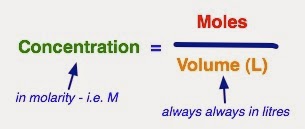
In your next  107 practical   and  your next   109 maths workshop   you are going to be dealing with  concentrations ,  and after that concentrations are going to keep popping up, so it would be good for you to know about the various ways we can talk about concentration... Let's start with a definition: Concentration  = The amount of a specified substance in a unit amount of another substance There are various ways concentrations can be expressed.... 1. As the weight of something per unit volume For example,   grams per litre .   i.e.  20 grams per litre   (written as   20 g  l -1 ) means there are 20 grams of substance in one litre of solution. or  34 milligrams per litre   (written as   34 m g  l -1 ) means there are 34 milli grams of substance in one litre of solution  (this is the same as saying  0.034 grams per litre ) 2. As a percentage concentration...