Posts

Showing posts with the label 107

practical 6 in a test-tube...

Image
In your next practical you will be having a good look at all those plates you spread last week, and you will be doing various tests such as the Gram stain, Oxidase test and Catalase test in order to characterise the bacteria you have grown . The day is split into the following activities: Activity 1 : I nterpret and describe the bacterial colonies  that have grown on the agar plates you set up during activity 2 on day 1 (this was using the  artificial mixture ) . Further characterise the bacteria using various tests such as the Gram Stain, Catalase test and Oxidase test. Activity 2 :    Interpret and describe the bacterial colonies that have grown on the agar plates you set up during activity 3 on day 1 (this was using the   mushroom compost ). Further characterise the bacteria using the Gram Stain and calculate the number of viable bacteria that were present in the compost. Activity 3 :  I...

practicals 5 & 6 in a test-tube

Practicals 5 and 6 are all about working with   bacteria .  You will be learning how to separate out the bacteria from a mixture, and how to then characterise these bacteria. ! IMPORTANT ! Practical 5 is divided into two parts.  You will be doing the first part one week, and then because the bacteria you are working with need time to grow, you will be doing the second part of the practical the next week.  During the next two weeks you will be: learning how to safely handle and manipulate microorganisms (using aseptic technique) using the microscope using various techniques to characterise bacteria such as the Gram Stain plating bacteria on agar plates to obtain single colonies testing bacteria for antibiotic sensitivity testing whether bacteria are anaerobic or aerobic determining viable cell counts There is quite a lot to do for this practical -  it is really important that you read your manual before you c...

practical 4 in a test-tube

Image
Practical 4  is just around the corner. Here is a summary of what you will be doing... In this practical you are going to be investigating how changes in pH effect the activity of an enzyme. In doing this you will be re-visiting techniques you have learnt in the previous practicals as well as learning new ones: Calculating amounts to make stock solutions Using the balance Preparing stock solutions from dry chemicals  Pipetting Using a pH meter Performing an enzyme assay Before you come you have to do the calculations in activity 1 - you will need to have the answers to these calculations in order to make your stock solutions. You must also do the pre-class test on VITAL Here is how your time will be split up: ACTIVITY 1:   Prepare  two  stock solutions - one is acidic the other is basic ACTIVITY 2:  Prepare a range of buffer solutions of different pHs - you will do this by mixing varying amounts of your acid and base stock sol...

Dilutions - don't be scared!

Dilutions   tend to worry first years! These come up a lot in 107 and 109. I think a lot of you just don't get along with the terminology that is used when people talk about dilutions.  Let me try to clarify things a little... Sometimes, dilutions are talked about in terms of  ratios . i.e. a  1:2 dilution  or a  1:3 dilution .  Remember that  ratios   tell you  how much of one thing there is in comparison to another thing .  So, for a   1:2 dilution   (which could also be written as a  '1 to 2 dilution' ) , this means that there will be one 'part' of one thing and two 'parts' of a second thing, and therefore three 'parts' in total.  Example: If you were asked to make a  1:2 dilution  of a   60 mM NaCl   solution, and the final volume required was  180 mls ,  then you would take   60 mls   of your   60 mM NaCl  solution and mix it with   120 mls  of...

VIDEO GUIDE: Using pipettes part 2

Here is  part 2 of using an automatic pipette ... (remember to watch part 1 in my previous post too!) (If the video is very slow to load, go into VITAL and watch it from there - it is in your 107 area...)

VIDEO GUIDE: Using pipettes part 1

In your next practical you will be using automatic pipettes. You really need to know what you are doing with these - if you use them incorrectly your measurements will be all wrong, and you may break the pipette too... So, we have put together a  two part video special on using automatic pipettes !!  Here is  part 1: selecting and setting your pipette , enjoy! (If the video is very slow to load, go into VITAL and watch it from there - look for it in your 107 area...)

all those different units for concentrations...

Image
In your next  107 practical   and  your next   109 maths workshop   you are going to be dealing with  concentrations ,  and after that concentrations are going to keep popping up, so it would be good for you to know about the various ways we can talk about concentration... Let's start with a definition: Concentration  = The amount of a specified substance in a unit amount of another substance There are various ways concentrations can be expressed.... 1. As the weight of something per unit volume For example,   grams per litre .   i.e.  20 grams per litre   (written as   20 g  l -1 ) means there are 20 grams of substance in one litre of solution. or  34 milligrams per litre   (written as   34 m g  l -1 ) means there are 34 milli grams of substance in one litre of solution  (this is the same as saying  0.034 grams per litre ) 2. As a percentage concentration...

3 very useful equations for lab work

Image
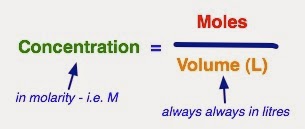
Get those calculators at the ready, concentration and dilution calculations are coming up in practical 3. To help you along with these, I though I'd share with you my   top 3 all time favorite fantastic equations!   I hope you will enjoy and cherish them as much as I have! In no particular order.... If your mass is in grams, your moles will be in mol, if your mass is in mg, your moles will be mmol and so on - remember what your units are! Molecular mass  is the mass of one mole of something  (so if you have the same mass as the molecular mass of something, you will have one mole - look at the equation above and check this works!)   Molecular mass is often given to you, but if it isn't you can easily calculate it by adding up the relative atomic masses of all the atoms that make up the molecule you are dealing with.... Again, if your moles are in mol, your concentration will be in M, if your moles are in mmol, your concentration...

Moles are coming!

Image
Moles are cute, at least this kind is!  image taken from http://en.wikipedia.org/wiki/Mole_(animal) You might not find the kind of mole you find in the lab quite so endearing at first, but you will soon come to realise that in science, you can't do without it... So what is a mole? 1 mole   is quite simply a number,   6.02 x 10 23  i n fact! (This is known as   Avogadro's number .) You could have  1 mole   of absolutely anything, it would just mean that you have  6.02 x 10 23  of w hatever that might be. For example, you might have  1 mole   of pennies - so that would be  6.02 x 10 23  pennies in total .... so how rich would you be if you had this many pennies I wonder ... We use moles when we talk about chemicals and chemical reactions - at levels where using grams or absolute numbers of atoms wouldn't make sense. It is much easier to write ' mole ' rather than  6.02 x 10 23  any time yo...